|
| (1R,5S)-3,4,5,6-Tetrahydro-1H-1,5-methanopyrido[1,2-a][1,5]diazocin-8(2H)-one |
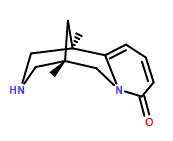
※ 화학명 : Cytisine, 98% (HPLC)
※ 등급 : APIs and Bioactives > Alkaloids, AChR Agonists
※ 판매 포장단위 : 50mg , 250mg , 500mg , 1g
※ 화학식 : C11H14N2O
※ CAS # : [485-35-8]
|
| IDENTITY |
|
| CAS Registry #: |
[485-35-8] |
| MDL Number: |
MFCD00136048 |
| MF: |
C11H14N2O |
| MW: |
190.24 |
| EINECS: |
207-616-0 | |
| SPECIFICATIONS & PROPERTIES |
|
| Purity: |
98% (HPLC) |
| Available Spectra: |
NMR, LCMS, HPLC |
| Physical Form: |
Light yellow crystalline powder |
| Melting Point: |
154-158°C |
| Boiling Point: |
218°C (2mmHg) |
| Long-Term Storage: |
Store long-term at -20°C |
| Shipping: |
Regulated for Shipping |
| UN #: |
2811 |
| Hazard Class: |
6.1 |
| Packing Group: |
III | | |
BIOLOGICAL INFO |
|
| Form: |
FREE BASE |
| Research Area: |
NEUROLOGICAL DISEASE |
REVIEW
Cytisine, also known as baptitoxine and sophorine, is a toxic alkaloid that occurs naturally in several plant genera, of the Faboideae subfamily of the Fabaceae family, including Laburnum, Anagyris, Thermopsis, Cytisus, Genista, Retama and Sophora. Cytisine is also present in Gymnocladus of the Caesalpinioideae subfamily. The palila (Loxioides bailleui, a bird), Uresiphita polygonalis virescens and Cydia species (moths), and possibly sheep and goats are not affected by the toxin for various reasons, and use m?mane, or parts thereof, as food. U. p. virescens caterpillars are possibly able to sequester the cytisine to give themselves protection from getting eaten; they have aposematic coloration which would warn off potential predators. Despite its toxicity (LD50 i.v., in mice ca.2 mg/kg), cytisine has been used medically to help with smoking cessation: it is less effective but much cheaper than similar products. Its molecular structure has some similarity to that of nicotine and it has similar pharmacological effects. Cytisine, a partial agonist that binds with high affinity to the alpha(4)beta(2) nicotinic acetylcholine receptor, is a low-cost treatment that may be effective in aiding smoking cessation. Analysis of clinical data has shown that cytisine is an effective treatment for smoking cessation with efficacy comparable to that of other currently licensed treatments. Given its low cost and potential for public health benefit, expedited licensing of cytisine for smoking cessation is certainly warranted.
REFERENCES
[1] |
Banko PC, Cipollini ML, Breton GW, Paulk E, Wink M, Izhaki I.Seed chemistry of Sophora chrysophylla (mamane) in relation to diet of specialist avian seed predator Loxioides bailleui (palila) in Hawaii. J Chem Ecol. 2002 Jul;28(7):1393-410. |
| [2] |
Rouden J, Lasne MC, Blanchet J, Baudoux J. (-)-Cytisine and Derivatives: Synthesis, Reactivity, and Applications. Chem Rev. 2013 Oct 11. |
| [3] |
Rogers E, Sherman S Review: Cytisine increases smoking abstinence. Ann Intern Med. 2013 Aug 20; |
| [4] |
Prochaska JJ, Das S, Benowitz NL.Cytisine, the worlds oldest smoking cessation aid. BMJ. 2013 Aug 23;347:f5198. |
Risk Description(s)
| R25: |
Toxic if swallowed. |
| R36/37/38: |
Irritating to eyes, respiratory system and skin |
Safety Description(s)
| S26: |
In case of contact with eyes, rinse immediately with plenty of water and seek medical advice. |
| S36/37: |
Wear suitable protective clothing and gloves. |
| S45: |
In case of accident or if you feel unwell, seek medical advice immediately (show the label where possible). |

|